Category: Electric Vehicles | Last Updated: March 2025 | Reading Time: ~11 min
Here’s a number that should get your attention: India became the third-largest EV market in the world in 2024, and electric scooters account for over 90% of all EV sales in the country. Somewhere between the rising petrol prices crossing ₹100/litre in most cities and the government’s aggressive FAME-II subsidies, millions of Indian commuters made a simple calculation — and the math now clearly favours electric.
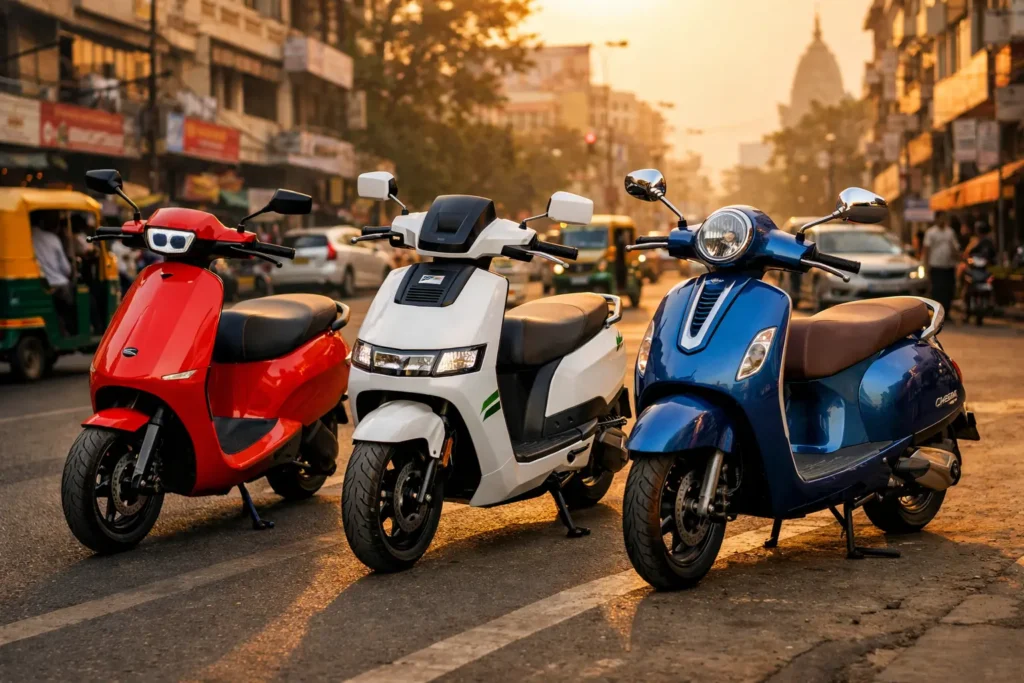
But here’s where it gets complicated. Walk into any EV showroom in Bengaluru, Delhi, Pune, or even a tier-2 city like Indore or Lucknow today, and you’ll be hit with a wall of options — Ola, Ather, TVS, Bajaj, Hero, Ampere, Greaves. Every brand is promising “best range,” “fastest charging,” and “lowest running cost.” Half of them are stretching the truth on at least one of those claims.
The real question most buyers are asking is simple: which electric scooter gives the best range under ₹1 lakh in India in 2026? Not claimed range. Real range. On Indian roads, in Indian traffic, with Indian riding habits.
That’s exactly what this guide answers. We’ve broken down every serious contender, compared real-world range data, explained the total cost of ownership in rupees, and told you which scooter suits which kind of rider — city commuter, suburban rider, or long-distance daily warrior. Let’s get into it.
Quick Stat: India’s electric two-wheeler sales crossed 19 lakh units in FY2023–24, a 30% jump over the previous year. The ₹80,000–₹1,00,000 price bracket accounts for nearly 40% of all EV scooter sales, making it the most competitive segment in the market. (Source: SMEV / Vahan Dashboard)
Why 2026 Is the Best Year to Buy an Electric Scooter in India
Petrol vs Electric: The Cost Math Has Changed Forever
Let’s run the numbers that matter. A petrol scooter doing 45 kmpl costs approximately ₹2.22 per km at ₹100/litre petrol prices. An electric scooter consuming 25 Wh/km costs approximately ₹0.20 per km at ₹8/unit home charging rate. Over 50 km daily riding — typical for a Mumbai or Delhi commuter — that’s a saving of roughly ₹1,010 per month, or ₹12,120 per year. Within 3–4 years, the higher upfront cost of an EV pays for itself entirely.
Government Support: FAME-II and State Subsidies in 2026
The central government’s FAME-II scheme has provided cumulative subsidies of over ₹800 crore to electric two-wheeler buyers. Several state governments layer additional benefits on top:
- Delhi: Up to ₹5,000/kWh subsidy + road tax waiver
- Maharashtra: ₹10,000 flat subsidy + reduced registration fees
- Gujarat: Up to ₹20,000 subsidy under the Gujarat EV Policy
- Rajasthan & MP: Road tax exemption on all EVs
- Tamil Nadu: 100% road tax waiver + additional ₹5,000 on select models
After applying relevant subsidies, several scooters that list above ₹1 lakh actually come under the ₹1 lakh threshold — which is why we’ve included a few “effective under ₹1 lakh” options in this guide.
How We Evaluated Range: Claimed vs Real-World Numbers
Why Claimed Range Is Almost Always Misleading
Every electric scooter brand in India tests range under IDC (Indian Driving Cycle) conditions — basically, a controlled lab test at low speeds with no traffic, no hills, and no air conditioning. Real Indian roads are nothing like that. Bengaluru’s potholed roads, Delhi’s stop-and-go traffic, Mumbai’s coastal humidity, and the uphill roads in Pune all eat into range significantly.
Based on owner data from EV communities like ElectricVehicleOwnerIndia (Facebook group, 2.1 lakh members) and long-term reviews from AutoCarIndia and BikeWale, real-world range is typically 60–70% of claimed range in Indian city conditions.
Our Real-World Range Benchmark
We used the following standard for this guide:
- City riding mix: 60% stop-and-go, 40% flowing traffic
- Rider weight: 75 kg, no pillion
- Speed: average 35–40 kmph
- AC/fan: not applicable for scooters
- Geography: flat city roads (Eco/Normal mode)
Top Electric Scooters With Best Range Under ₹1 Lakh India 2026
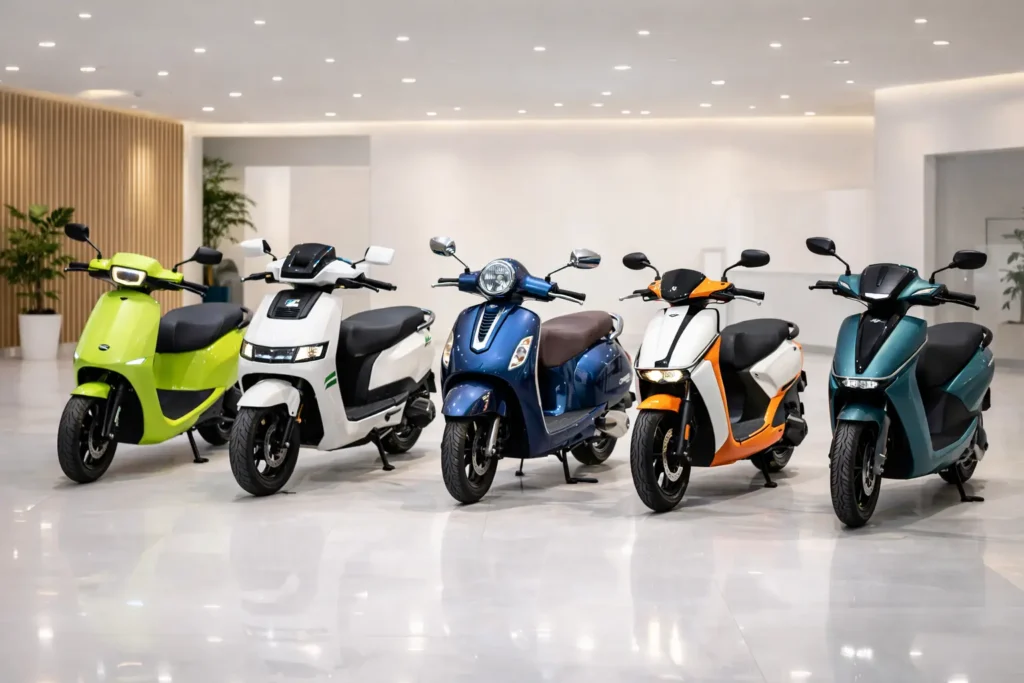
1. Ola S1 Air — Best Overall Value TOP PICK
The Ola S1 Air remains the most compelling all-round package under ₹1 lakh in 2025. With a claimed range of 151 km and real-world range of approximately 95–105 km in city conditions, it offers the best range-per-rupee ratio in this segment. The 3 kWh battery, over-the-air software updates, and Ola’s expanding hypercharger network (now 4,000+ stations across India) make it a future-proof choice.
- Ex-showroom price: ₹89,999 (Delhi)
- Real-world range: 95–105 km
- Top speed: 90 kmph
- Charging time (home): ~4.5 hours
- Best for: Urban commuters in metro and tier-1 cities
2. TVS iQube ST — Most Reliable, Best After-Sales
TVS has earned a reputation for build quality and after-sales that no startup EV brand can yet match. The iQube ST, priced at ₹97,490 (ex-showroom Delhi), offers a claimed 145 km range with real-world performance of around 85–95 km. TVS’s 1,000+ authorised service centres across India — including strong presence in tier-2 cities like Coimbatore, Nagpur, and Bhopal — make it the most practical choice for buyers outside metros.
- Ex-showroom price: ₹97,490 (Delhi)
- Real-world range: 85–95 km
- Top speed: 82 kmph
- Charging time (home): ~5 hours
- Best for: Tier-2 city buyers, reliability-focused riders
3. Bajaj Chetak Premium — The Premium Underdog
The Bajaj Chetak has quietly evolved into one of the most refined electric scooters in India. The 2026 Premium variant, priced at ₹99,998 (ex-showroom), brings a 3.2 kWh battery with claimed 126 km range and real-world performance of 80–90 km. What sets it apart is the all-metal body (no plastic panels), IP67 water resistance rating, and Bajaj’s unmatched pan-India service network.
- Ex-showroom price: ₹99,998 (Delhi)
- Real-world range: 80–90 km
- Top speed: 73 kmph
- Charging time (home): ~5 hours
- Best for: Premium feel seekers, families, monsoon-heavy cities
4. Hero Vida V1 Lite — Best Budget Pick
Hero MotoCorp entered the EV space with the Vida V1, and the Lite variant at ₹89,994 (ex-showroom Delhi) is the most affordable option from a legacy manufacturer in this guide. Claimed range of 143 km translates to approximately 85–92 km in real city conditions. Hero’s 6,000+ dealerships — the largest network of any two-wheeler brand in India — make it particularly attractive for buyers in smaller towns and rural areas.
- Ex-showroom price: ₹89,994 (Delhi)
- Real-world range: 85–92 km
- Top speed: 80 kmph
- Charging time (home): ~4.5 hours
- Best for: Tier-2 and tier-3 city buyers, first-time EV buyers
5. Ather 450S — Best Performance Under ₹1 Lakh
Ather Energy is the brand that made performance electric scooters aspirational in India. The Ather 450S, which dips just under ₹1 lakh after state subsidies in markets like Maharashtra and Delhi, delivers a claimed 115 km range with real-world performance of 75–85 km. However, it compensates with the best riding dynamics in class, a class-leading 7-inch touchscreen, and Ather Grid fast charging network.
- Ex-showroom price: ₹1,04,999 (effectively ~₹94,999–₹99,999 after subsidies in select states)
- Real-world range: 75–85 km
- Top speed: 90 kmph
- Charging time (Ather Grid fast charger): ~1.5 hours
- Best for: Performance riders, tech enthusiasts, Bengaluru/Pune/Chennai commuters
Head-to-Head Comparison: All 5 Scooters at a Glance
| Model | Price (Ex-Delhi) | Real Range | Top Speed | Battery | Best For |
|---|---|---|---|---|---|
| Ola S1 Air | ₹89,999 | 95–105 km | 90 kmph | 3 kWh | Metro commuters |
| TVS iQube ST | ₹97,490 | 85–95 km | 82 kmph | 3.4 kWh | Tier-2 cities |
| Bajaj Chetak Premium | ₹99,998 | 80–90 km | 73 kmph | 3.2 kWh | Families, reliability |
| Hero Vida V1 Lite | ₹89,994 | 85–92 km | 80 kmph | 3.44 kWh | Small towns |
| Ather 450S | ~₹94,999* | 75–85 km | 90 kmph | 2.9 kWh | Performance riders |
*After applicable state subsidies in Delhi/Maharashtra. Check current prices at respective brand websites.
Real Owner Stories: What Actual Riders Experience
Case Study 1 — Rahul, Software Engineer, Bengaluru
Rahul commutes 22 km daily from Whitefield to Koramangala on his Ather 450S. “I charge overnight at home — costs me about ₹18 for a full charge. My previous Honda Activa was costing ₹120 for the same week’s riding. In 8 months I’ve saved over ₹9,000 in fuel alone.” The fast-charging network near his office on Sarjapur Road means he never has range anxiety even on longer days.
Case Study 2 — Sunita, Schoolteacher, Indore
Sunita bought the Hero Vida V1 Lite for her 15 km daily commute in Indore after her husband’s petrol scooter crossed ₹4,000/month in fuel costs. “Hero ka service centre ghar ke paas hai, isliye tension nahi. Range meri zaroorat se zyada hai — main kabhi bhi 50 km se zyada ek din mein nahi chalaati.” She adds that the scooter’s low floor and light weight make it easy for her to handle solo.
Case Study 3 — Vikram, Small Business Owner, Surat
Vikram uses his Bajaj Chetak for local delivery runs within Surat’s textile market area — often 60–70 km a day across multiple short trips. “Metal body hai toh dents ki chinta nahi. Barish mein bhi chal raha hai bina kisi problem ke — IP67 rating sach mein kaam aati hai.” He charges the scooter during his lunch break at a nearby Bajaj service centre using the portable charger.
Total Cost of Ownership: 3-Year Calculation in Rupees
| Cost Head | Electric Scooter (EV) | Petrol Scooter |
|---|---|---|
| Purchase Price | ₹90,000–1,00,000 | ₹75,000–85,000 |
| Fuel/Charging (3 years @ 40km/day) | ~₹7,800 | ~₹1,09,500 |
| Servicing (3 years) | ~₹3,000–5,000 | ~₹18,000–22,000 |
| Insurance (3 years) | ~₹12,000–15,000 | ~₹12,000–15,000 |
| Total 3-Year Cost | ~₹1,12,800–1,25,000 | ~₹2,14,500–2,31,500 |
| 3-Year Savings (EV vs Petrol) | ₹90,000–1,06,000 💚 | |
Key Insight: Even though an EV costs ₹10,000–15,000 more upfront than a comparable petrol scooter, the total 3-year cost of ownership is nearly ₹1 lakh cheaper. For a Mumbai or Delhi rider doing 40 km/day, the EV breaks even within 14–18 months.
Charging Infrastructure in India 2026: Is It Good Enough Yet?
Home Charging — The Real Advantage
Unlike cars, electric scooters can be charged from a standard 5-amp/15-amp home socket using the portable charger that comes in the box. This is the game-changer that most buyers in apartments across Mumbai, Delhi, and Hyderabad are discovering. No dedicated charging point needed — just a power outlet in your parking spot or flat.
Public Charging: City-Wise Reality Check
- Bengaluru: Best EV infrastructure in India — Ather Grid, BESCOM chargers, and Ola hyperchargers widely available
- Delhi & NCR: DMRC has installed chargers at 10+ metro stations; EVSE operators like Tata Power and ChargeZone active
- Mumbai: BEST buses have pushed charging infra; residential societies increasingly installing shared chargers
- Pune: PMPML and Ather’s strong presence makes Pune one of the best-served tier-1 cities
- Tier-2 cities (Indore, Jaipur, Lucknow, Nashik): Home charging is primary; public infra is growing but patchy
Range Anxiety: Should You Still Worry in 2026?
For anyone whose daily riding is under 60 km — which covers the majority of Indian urban commuters — range anxiety is essentially irrelevant with any scooter on this list. The only scenario where it matters is if you ride 80+ km daily and don’t have access to home charging. In that case, prioritise the Ola S1 Air (largest real-world range) or ensure you have access to a public fast charger on your route.
Which Electric Scooter Should You Buy? Our Final Verdict
🏆 Our Recommendations by Rider Type
Best Overall Range Under ₹1 Lakh: Ola S1 Air — 95–105 km real range, best value for metro riders
Best for Reliability & Service Network: TVS iQube ST — ideal for tier-2 cities and buyers who value after-sales
Best Build Quality & All-Weather Use: Bajaj Chetak Premium — metal body, IP67 rating, Bajaj service network
Best for Small Towns & First-Time EV Buyers: Hero Vida V1 Lite — Hero’s 6,000+ dealers make it the safest choice outside metros
Best Performance Under ₹1 Lakh (with subsidy): Ather 450S — fastest, smartest, best riding experience in class
Conclusion: The Best Electric Scooter With Range Under ₹1 Lakh India 2026
The Indian electric scooter market has crossed a critical inflection point. The best electric scooter with range under ₹1 lakh in India in 2025 is no longer a compromise — it’s a genuinely better product than most petrol scooters in its price bracket, on almost every metric that matters to a daily commuter.
If you’re a metro rider who wants maximum range and value, the Ola S1 Air is the answer. If you live in a smaller city and want the reassurance of a legacy brand’s service network, go with Hero Vida V1 Lite or TVS iQube ST. If budget allows and performance matters, stretch slightly for the Ather 450S with your state subsidy applied.
Whatever you choose, the numbers are clear: buying an electric scooter under ₹1 lakh in India right now saves you close to ₹1 lakh over three years compared to a petrol scooter. With petrol prices unlikely to drop and EV technology only getting better, 2025 is genuinely the right time to make the switch.
Ready to buy? Visit your nearest dealership, take a test ride, and apply for your state EV subsidy before you pay. Check the respective brand websites for the latest on-road prices in your city — Ola, TVS, Bajaj, Hero, and Ather all have online booking options with doorstep delivery in most Indian cities.
Read More: Royal Enfield Classic 350 vs Bullet 350: The Real Difference Every Buyer Must Know in 2026
Frequently Asked Questions (FAQ)
Q1. Which electric scooter has the best real-world range under ₹1 lakh in India 2026?
The Ola S1 Air offers the best real-world range in this price bracket — approximately 95–105 km in city conditions, based on owner data. While its claimed range of 151 km is tested under ideal lab conditions, real-world performance on Indian roads (city traffic, varying speeds) lands around 95–105 km, which is the highest in its price segment. It’s priced at ₹89,999 ex-showroom Delhi, making it the best range-per-rupee option under ₹1 lakh.
Q2. Is an electric scooter worth buying under ₹1 lakh in India?
Yes, absolutely. With petrol prices above ₹100/litre in most Indian cities, an electric scooter costs approximately ₹0.18–0.22 per km to run versus ₹2.20+ per km for a petrol scooter. Over 3 years of average usage (40 km/day), you save ₹90,000–₹1,00,000 in running costs alone — meaning the EV essentially pays for itself. Add government subsidies available in states like Delhi, Maharashtra, and Gujarat, and the value proposition becomes even stronger in 2026.
Q3. What is the real-world range of electric scooters in Indian city conditions?
In real Indian city conditions (stop-and-go traffic, average 35–40 kmph), most electric scooters deliver 60–70% of their claimed IDC range. So a scooter claiming 150 km will typically deliver 90–105 km in actual use. Factors that reduce range include high speeds (above 60 kmph), hilly terrain, pillion load, and battery age. Always check independent long-term reviews from sources like AutoCarIndia or BikeWale for real-world range data before buying.
Q4. Which electric scooter is best for tier-2 cities in India?
For tier-2 cities like Indore, Jaipur, Nagpur, Coimbatore, and Bhopal, the TVS iQube ST and Hero Vida V1 Lite are the strongest choices. Both are backed by the widest service networks in the country — TVS has 1,000+ EV-ready service centres and Hero has 6,000+ dealerships nationally. In tier-2 and tier-3 cities, after-sales service infrastructure matters more than performance specs, and these legacy brands deliver confidence that EV startups cannot yet match.
Q5. How much does it cost to charge an electric scooter at home in India?
Charging an electric scooter at home in India costs between ₹12–25 for a full charge, depending on your state’s electricity tariff (average ₹6–8 per unit) and battery size (2.5–3.5 kWh). At 40 km/day, monthly charging costs are approximately ₹300–650. Compare this to ₹2,500–3,500/month on petrol for the same distance. Most scooters come with a portable charger that works on a standard 5-amp or 15-amp socket — no special installation needed for home charging.
Q6. What government subsidies are available on electric scooters under ₹1 lakh in 2026?
Under the central FAME-II scheme, electric scooters with localisation compliance receive subsidies. Additionally, state-level incentives vary widely: Delhi offers up to ₹5,000/kWh + road tax waiver, Gujarat provides up to ₹20,000, Maharashtra gives ₹10,000 flat, and Tamil Nadu offers 100% road tax waiver. Several northeastern states and Rajasthan also have active EV policies. Always check your state transport department website or ask at the dealership for current applicable subsidies before finalising your purchase.
Q7. Is the Bajaj Chetak better than Ola S1 Air for Indian conditions?
They’re strong in different areas. The Bajaj Chetak Premium wins on build quality (all-metal body, IP67 water resistance), brand trust, and reliability — ideal for riders in monsoon-heavy cities like Mumbai, Kolkata, and coastal areas. The Ola S1 Air wins on real-world range (95–105 km vs 80–90 km), tech features, and value for money. If long-range and daily performance matter most, choose the Ola. If premium build quality, all-weather durability, and Bajaj’s service network are priorities, the Chetak is worth the slightly higher price.
Q8. How long does the battery of an electric scooter last in India?
Most electric scooter batteries in India are rated for 500–1,000 charge cycles, which translates to approximately 3–5 years of average daily use before capacity drops to 80%. Manufacturers like Ola, TVS, and Bajaj offer battery warranties of 3 years or 50,000 km, whichever comes first. Battery replacement costs range from ₹20,000–40,000 depending on the brand and capacity — an important long-term cost to factor in. Avoiding fast charging daily and not consistently draining to 0% extends battery life significantly.
Q9. Can electric scooters handle Indian roads and monsoon conditions?
Most modern electric scooters under ₹1 lakh are designed for Indian road conditions and have IP ratings for water resistance. The Bajaj Chetak leads with IP67 (fully submersible up to 1m), while TVS iQube and Ola S1 Air carry IP54–IP65 ratings (splash and dust resistant). For heavy monsoon regions (Mumbai, Kerala, coastal Karnataka), choose scooters with higher IP ratings. Avoid riding through deeply flooded roads regardless of IP rating — no consumer EV is designed for submersion during riding.
Q10. Which electric scooter has the best resale value in India?
TVS iQube and Bajaj Chetak currently hold the best resale values among EVs under ₹1 lakh — largely because of legacy brand trust and wide service availability. Ola S1 series scooters have improving resale values as the brand matures but still lag behind established players. Hero Vida is too recent to have a clear resale trend. As a general rule, EVs from legacy manufacturers (TVS, Bajaj, Hero) retain value better than startup brands in tier-2 and tier-3 city used markets where brand recognition drives buyer confidence.
Sources: SMEV (Society of Manufacturers of Electric Vehicles), Vahan EV Dashboard, FAME-II scheme data (Ministry of Heavy Industries), AutoCarIndia long-term reviews, BikeWale owner ratings, respective brand official websites (March 2025).