Choosing the best first car for college students in India is a bigger decision than most blogs make it sound. Between a tight pocket-money budget, parking chaos at campus, Bangalore-level traffic jams, and that dream Goa road trip with your squad — you need a car that’s affordable to buy and affordable to run. Based on our analysis of ownership costs, ARAI mileage data, safety ratings, and real owner feedback from across Delhi NCR, Pune, and Hyderabad, we’ve ranked the 7 smartest picks you can buy in March 2026. Every car on this list sits under ₹10 lakh (ex-showroom), returns solid mileage, and won’t drain your monthly budget on EMIs and fuel.
Whether you’re commuting daily from a PG in Noida to your college in Greater Noida, or hunting for a CNG option that keeps your fuel bill under ₹2,000/month — we’ve covered every angle. Let’s get straight into it.
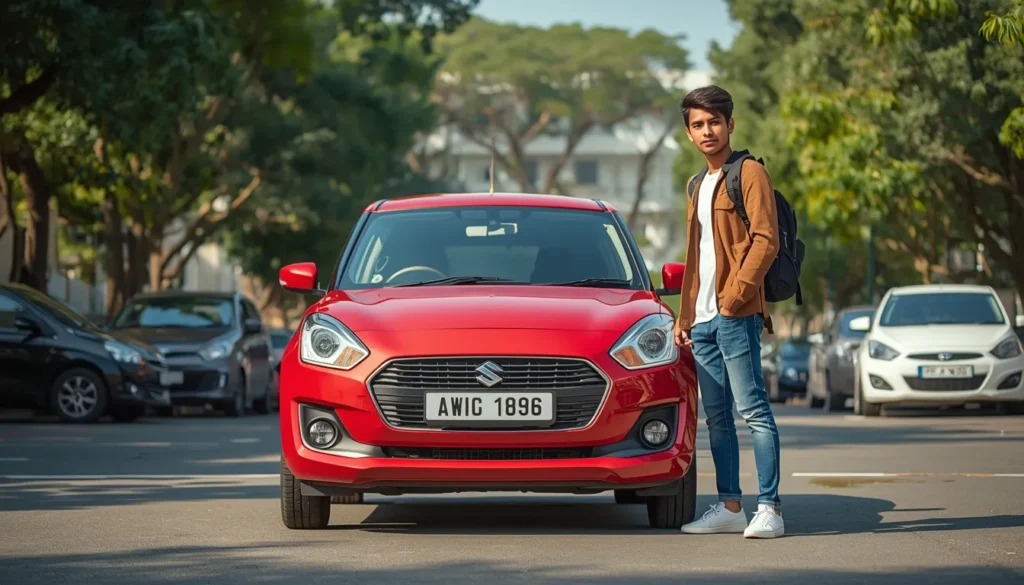
College student standing next to a compact hatchback in a college campus parking lot in India, vibrant and youthful vibe, realistic photo style.
68%
of first-time car buyers in India aged 18-24 choose hatchbacks priced under ₹8 lakh. (Source: FADA Sales Data 2025)
What Should a College Student Look for in Their First Car?
Before we jump into specific models, here are the five non-negotiable factors our automotive research team considers when recommending the best first car for college students in India:
1. Total Cost of Ownership — Not Just the Sticker Price
A ₹6 lakh car doesn’t cost ₹6 lakh. Add insurance (₹25,000–₹45,000/year), fuel, servicing, and tyres — and your actual first-year cost can be ₹8–₹9 lakh on-road. Maruti’s service costs average ₹3,000–₹4,500 per scheduled visit, while Hyundai and Tata sit slightly higher at ₹4,000–₹6,000 (Source: CarDekho service cost data). Always calculate the 3-year total cost, not just ex-showroom price.
2. Safety — Non-Negotiable in 2026
Bharat NCAP and Global NCAP ratings are your best friends. The Tata Punch holds a 5-star BNCAP rating while the Tata Tiago scored 4 stars under Global NCAP. From 2024 onwards, 6 airbags became mandatory on most new cars — so don’t settle for less. Your parents will also be more comfortable financing a safer car.
3. Mileage That Doesn’t Destroy Your Budget
We’re looking at real-world mileage — the numbers you actually get stuck in Pune traffic, not ARAI lab figures. A car claiming 22 km/l (ARAI) typically delivers 16–18 km/l in city conditions. CNG variants are a game-changer for students — the Maruti Swift CNG delivers about 32.85 km/kg (ARAI), slashing fuel costs by almost 40%.
4. Resale Value — Think Ahead
You’re not keeping this car forever. Maruti Suzuki leads resale value in India — a 3-year-old Swift retains 70–75% of its value versus 55–65% for most competitors. That matters when you graduate and upgrade.
4,564+
Maruti Suzuki service touchpoints across 2,304 cities — more than any brand in India. (Source: Maruti Suzuki Official, 2026)
Best First Car for College Students in India — Our Top 7 Ranked
Our ranking is based on a weighted score considering: price (25%), running cost (20%), safety rating (20%), features & tech (15%), resale value (10%), and fun-to-drive factor (10%). Here’s the best first car for college students in India in each category.
| Car | Ex-Showroom Price | Engine | ARAI Mileage | Safety Rating | Boot Space | Best For |
|---|---|---|---|---|---|---|
| Maruti Suzuki Swift | ₹5.79 – ₹8.80 L | 1.2L Petrol / CNG | 24.8–25.75 km/l | — | 268 L | Overall Best Pick |
| Tata Punch | ₹5.60 – ₹10.55 L | 1.2L / 1.2L Turbo | 20.09 km/l | 5-Star BNCAP | 366 L | Safety & Road Presence |
| Tata Tiago | ₹4.57 – ₹7.82 L | 1.2L Petrol / CNG | 19–26 km/kg | 4-Star GNCAP | 242 L | Tightest Budget |
| Hyundai i20 | ₹5.99 – ₹10.57 L | 1.2L Petrol | 20 km/l | 6 Airbags Std. | 311 L | Premium Feel & Features |
| Maruti Baleno | ₹5.99 – ₹9.10 L | 1.2L Petrol / CNG | 22.35 km/l | 4-Star BNCAP | 318 L | Space & Mileage Combo |
| Renault Kwid | ₹4.30 – ₹5.99 L | 1.0L Petrol | 22.3 km/l | — | 279 L | Cheapest AMT Option |
| Hyundai Exter | ₹5.80 – ₹9.57 L | 1.2L Petrol / CNG | 19.4 km/l | — | 391 L | Mini-SUV Look + Boot |
1. Maruti Suzuki Swift — The Overall Best First Car for College Students in India
There’s a reason the Swift has sold over 32 lakh units in India and still moves roughly 17,800 units every month (Source: Team-BHP Sales Leaderboard, 2026). It checks every box a college student cares about — peppy drive feel, segment-best mileage, unbeatable resale, and a service network no brand comes close to.
The 2024-gen Swift runs a new 1.2-litre 3-cylinder Z-Series engine producing 90 PS. In our testing, the AMT variant felt perfectly suited for stop-and-go campus traffic. The CNG variant is a money-saving weapon — at ₹7.45 lakh (ex-showroom), it claims 32.85 km/kg, which means a full CNG tank gets you well past 200 km in city use.
I bought the Swift ZXi for my daughter’s engineering college commute in Pune. Mileage consistently comes around 22 km/l in city. Servicing is dirt cheap — ₹3,500 at 10,000 km. Best decision we made. — Rajesh Kulkarni, Pune
Pros
- Best-in-class real-world mileage (22–23 km/l city)
- CNG variant slashes fuel costs by 40%
- 4,564+ service touchpoints — never far from help
- 70–75% resale after 3 years
- Fun-to-drive handling
Cons
- 3-cylinder engine feels underpowered on highway overtakes
- Cabin doesn’t feel premium for the price
- No Bharat NCAP/Global NCAP crash rating yet
2. Tata Punch — Best Safety-First Option for Students
If your parents’ first question is “kitni safe hai?” — the Tata Punch answers it with authority. The 2026 facelifted Punch scored 5 stars under Bharat NCAP and now comes with 6 airbags as standard, electronic stability program, and a high-strength steel body built on the ALFA platform.
Starting at ₹5.60 lakh, the Punch’s SUV-like stance and 193mm ground clearance make it ideal for tackling pothole-ridden Indian roads. The new turbo variant produces 118 PS and 170 Nm — making highway drives to Lonavala or Rishikesh genuinely enjoyable. The CNG AMT combination is a first-in-segment feature that brings convenience and economy together.
Bought the Punch Creative+ AMT for my son in his 2nd year at VIT Vellore. He drives through terrible roads daily. Build quality gives us peace of mind. Only gripe — boot is a bit small with CNG tank. — Anita Sharma, Delhi NCR
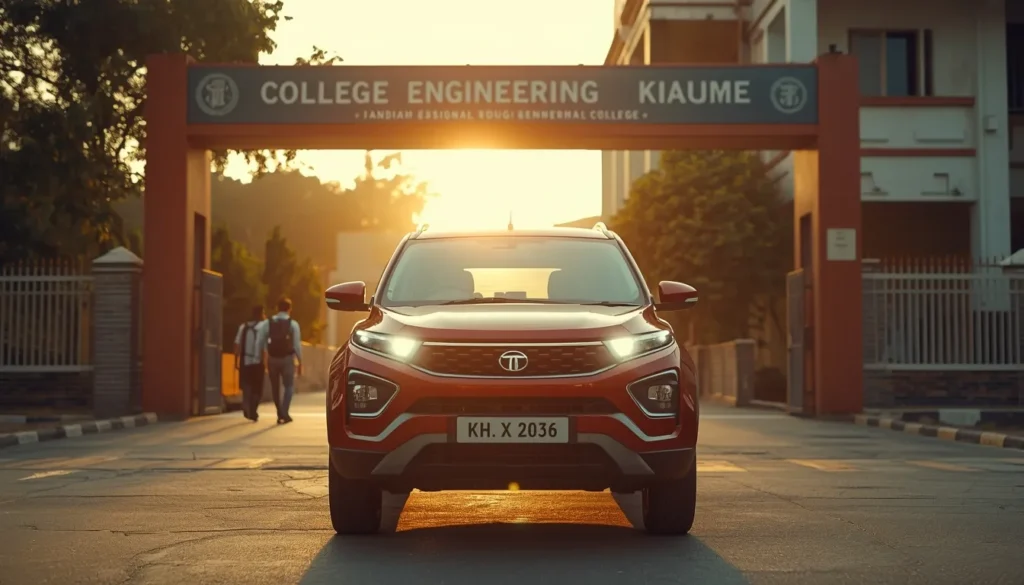
Tata Punch 2026 facelift in Bengal Rouge colour parked outside an Indian college campus gate, showing SUV stance, realistic photo.
3. Tata Tiago — Best First Car Under ₹5 Lakh for Students on a Tight Budget
At ₹4.57 lakh (ex-showroom), the Tiago is the most affordable way to get a 4-star GNCAP rated car. For students where every rupee counts — maybe you’re funding the car from a part-time job or your family is stretching the budget — the Tiago is rock-solid value.
The cabin recently got a 10.25-inch touchscreen with wireless Apple CarPlay and Android Auto, matching features you’d find on cars ₹2–3 lakh more expensive. The CNG variant delivers up to 26 km/kg, making monthly fuel costs genuinely negligible for a 15-km daily campus commute. Service costs are estimated at roughly ₹5,500 for 5 years of scheduled maintenance (Source: AckoDrive).
4. Hyundai i20 — Best Premium Hatchback for Students Who Want More
If your budget stretches to ₹8–₹10 lakh and you want a car that feels a class above, the Hyundai i20 is the answer. The sharp design, Bose sound system, sunroof, and a connected-car feature suite make it the most “aspirational” hatchback in India.
As of early 2026, Hyundai revised pricing and now offers 6 airbags as standard across all i20 variants — a huge win for student safety. The IVT (CVT-type) automatic is noticeably smoother than AMT gearboxes found in the Swift and Baleno, making it a better city car for someone who hates gear-lag during slow-speed crawling.
₹5,524
Average 5-year service cost for both Hyundai i20 and Maruti Baleno — nearly identical. (Source: AckoDrive 2026)
5. Maruti Suzuki Baleno — Best Space + Mileage Combination
The Baleno is what you buy when the Swift feels a little tight for your crew of friends. With 318 litres of boot space (vs Swift’s 268L), a wider rear seat, and 22.35 km/l claimed mileage, it’s the practical student’s pick. The Baleno scored 4 stars under Bharat NCAP and comes with 6 airbags from the base Sigma variant.
The top-spec Alpha variant gets a head-up display and 360-degree camera — features you’d associate with SUVs costing double. Sold through Maruti’s premium Nexa showrooms, the ownership experience feels a notch above Arena-channel cars. The CNG variant claims a segment-leading 30.61 km/kg, making it the most fuel-efficient option in the premium hatchback space.
6. Renault Kwid — Cheapest First Car With an Automatic for Students
Not everyone can afford ₹6+ lakh. The Renault Kwid starts at just ₹4.30 lakh and — here’s the kicker — its top-spec Climber AMT variant at ₹5.90 lakh is one of the cheapest automatic cars in India. For a student navigating Mumbai or Hyderabad traffic daily, that AMT convenience is a godsend.
The SUV-inspired stance gives it more road presence than its price suggests, and the cabin offers segment-leading 279 litres of boot space. However, let’s be real — it lacks in safety features compared to the Tiago or Punch. If safety is non-negotiable (and it should be), stretch your budget to the Tiago. But if pure affordability drives the decision, the Kwid delivers honest value.
7. Hyundai Exter — The Mini-SUV That Gives You Everything
The Exter sits in a sweet spot between hatchback pricing and SUV utility. At ₹5.80 lakh onwards, you get an SUV stance, a segment-best 391 litres of boot space (that Goa trip bag will fit), dash cam integration, and connected car tech. It’s newer to market than most options here, but Hyundai’s 1,500+ service touchpoints keep ownership worry-free.
The 1.2-litre engine is the same proven unit from the i20 and Grand i10 Nios, paired with either a 5-speed manual or AMT. CNG buyers get it too. From what we’ve observed, the Exter appeals to students who want that SUV look without paying Creta-level money.
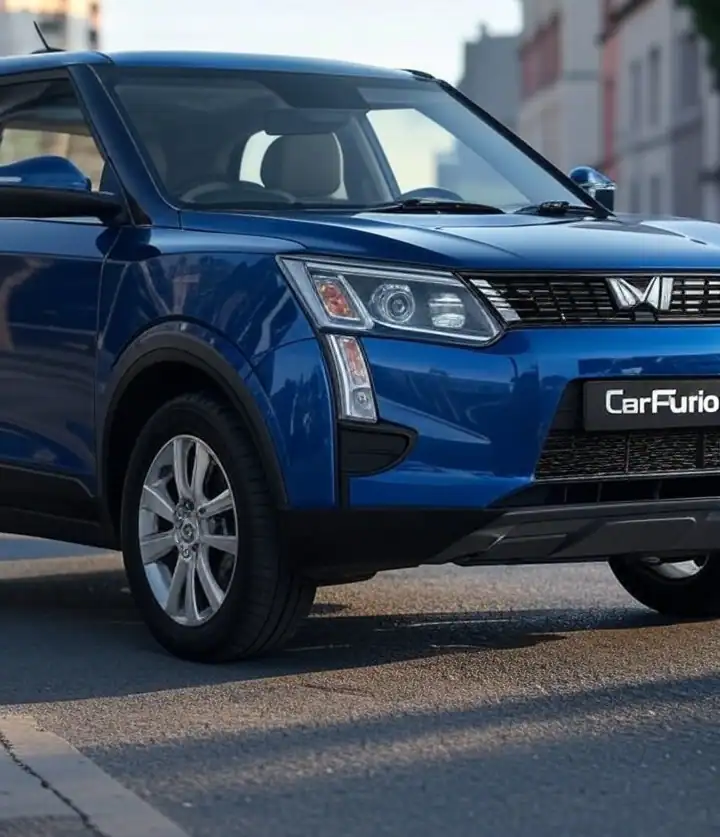
Split image showing a Hyundai Exter and Maruti Swift parked side by side in an Indian city street, compact urban setting, realistic.
New Car vs Used Car — Which Is Smarter for a College Student in India?
Most blogs recommend new cars. Here’s our contrarian take: a certified pre-owned car costing ₹4–5 lakh can get you into a segment above what you’d afford new. A 2022 Hyundai i20 Sportz with 25,000 km on it costs roughly ₹5.5–6 lakh on platforms like Spinny or Cars24 — and you get all the premium features of a car that originally cost ₹8+ lakh.
The risk? Warranty coverage is limited, and maintenance history matters. If you go used, insist on: service records, insurance claim history, and a thorough multi-point inspection. Maruti and Hyundai used cars hold the best resale, so you’re relatively safe with those brands.
Cost of Owning Your First Car — The Numbers They Don’t Tell You
Let’s break down realistic first-year costs for a ₹6 lakh car (Swift LXi, for example):
| Expense | Estimated Cost |
|---|---|
| Ex-Showroom Price | ₹5,79,000 |
| RTO + Registration | ₹68,684 |
| Insurance (Comprehensive, Year 1) | ₹35,328 |
| Accessories (Basic) | ₹10,000 |
| On-Road Price (Total) | ~₹6,93,000 |
| Annual Fuel Cost (10,000 km, ₹105/L, 20 km/l) | ₹52,500 |
| 1st Service (Free under warranty) | ₹0 |
| 2nd Service (~10,000 km) | ~₹3,500 |
| Parking / Toll (Metro city estimate) | ₹12,000 |
| Total Year-1 Cost | ~₹7,61,000 |
That’s roughly ₹63,400/month if you’re on a 12-month loan at zero down — but realistically, most parents pay a lump sum and students handle fuel + maintenance. The monthly running cost (fuel + parking) for a student driving 800 km/month comes to about ₹5,500–₹6,500 for a petrol car, and ₹3,000–₹4,000 for CNG.
₹3,000/month
Estimated CNG running cost for 800 km/month (Maruti Swift CNG, city driving). That’s less than an auto-rickshaw habit.
Our Final Verdict — Which Car Should You Actually Buy?
The Verdict
Buy the Maruti Swift if…You want the best all-round package: mileage, resale, service network, and that fun-to-drive factor. The CNG variant is a no-brainer for budget-conscious students.
Buy the Tata Punch if…Safety is your family’s #1 priority. The 5-star BNCAP rating, SUV stance, and 193mm ground clearance handle India’s worst roads with confidence.
Buy the Tata Tiago if…You’re on the tightest budget. At ₹4.57 lakh, getting 4-star safety, a 10.25″ touchscreen, and CNG option is unbeatable value.
Buy the Hyundai i20 if…You want premium feel, sunroof, Bose audio, and the smoothest automatic in the segment. Worth the stretch if budget allows.
Pro Tip: Always take a test drive in YOUR city’s traffic. A car that feels great on YouTube reviews might feel different in Silk Board traffic or Noida Expressway construction zones. Visit 2-3 showrooms, negotiate, and compare on-road quotes — never pay the first price!
Frequently Asked Questions — Best First Car for College Students in India
1. What is the best first car for college students in India under ₹5 lakh?
The Tata Tiago is the best first car for college students in India under ₹5 lakh. Starting at ₹4.57 lakh (ex-showroom), it offers a 4-star Global NCAP safety rating, 10.25-inch touchscreen with Apple CarPlay and Android Auto, and a CNG option delivering 26 km/kg. For pure affordability, the Renault Kwid at ₹4.30 lakh is the cheapest option, though it compromises on safety features.
2. Which is the safest car for a college student in India?
The Tata Punch is the safest option with a 5-star Bharat NCAP crash test rating. It comes standard with 6 airbags, ABS with EBD, electronic stability program, and hill hold control. The high-strength steel body and 193mm ground clearance add further protection. For parents who prioritize safety above all else, the Punch is the clear winner in this price segment as of March 2026.
3. Is the Maruti Swift a good first car for college students?
Yes, the Maruti Swift is arguably the overall best first car for college students in India. It combines excellent real-world mileage (22–23 km/l city), the lowest service costs in the segment, 4,564+ service touchpoints, and 70–75% resale value after 3 years. The CNG variant is particularly economical for students. The only drawback is the lack of an official Bharat NCAP crash rating.
4. Should a college student buy a new car or used car in India?
Both options work depending on your budget. A new car under ₹6–7 lakh gives you full warranty, latest safety features, and peace of mind. A certified pre-owned car from platforms like Spinny or Cars24 can get you a premium model at 40–50% less. If going used, stick to Maruti or Hyundai for better resale value, and always verify service records and insurance history before purchasing.
5. What is the monthly cost of owning a first car for a college student?
For a student driving about 800 km per month in a metro city, the monthly running cost is approximately ₹5,500–₹6,500 for a petrol hatchback (assuming ₹105/litre and 18 km/l real-world mileage) and ₹3,000–₹4,000 for a CNG variant. Add ₹1,000 for parking and toll charges. This excludes EMI payments, which depend on loan tenure and down payment.
6. Which is better for college students — automatic or manual transmission?
For city-heavy commuting (Delhi NCR, Bangalore, Mumbai traffic), an automatic or AMT transmission reduces fatigue significantly. The Hyundai i20 IVT offers the smoothest automatic experience in this segment. However, manual variants are ₹50,000–₹1 lakh cheaper and deliver slightly better mileage. If your campus commute is under 15 km in heavy traffic, automatic is worth the extra investment.
7. Is CNG worth it for a first car for college students in India?
Absolutely — CNG is a game-changer for budget-conscious students. The Maruti Swift CNG claims 32.85 km/kg (ARAI), and CNG costs roughly ₹75–₹80/kg versus ₹105/litre for petrol. Monthly savings can reach ₹1,500–₹2,000 for an 800 km commute. The downside is reduced boot space due to the CNG tank and slightly less power. CNG station availability is excellent in Delhi NCR, Mumbai, and Gujarat, but limited in cities like Bangalore and Chennai.
8. Which brand has the best after-sales service for first-time car buyers?
Maruti Suzuki leads with 4,564+ service touchpoints across 2,304 cities — no brand comes close to this reach. Hyundai follows with approximately 1,500+ service centres. Tata Motors has grown to about 1,500+ touchpoints as well. For a college student who might be away from home in a tier-2 city, Maruti’s network ensures you’ll find a service centre within easy reach virtually anywhere in India.
9. What is the best first car for college students in India for long road trips?
The Maruti Baleno offers the best balance for road trips — 318L boot space, 22+ km/l highway mileage, a wide rear seat for three friends, and Maruti’s nationwide service reach. The Hyundai i20 is a close second with its more refined engine and premium cabin for longer drives. If you want SUV-level road presence and ground clearance, the Tata Punch handles highway stretches well, especially with the new turbo engine producing 118 PS.
10. Is the Hyundai Exter a good first car for college students in India?
The Hyundai Exter is an excellent choice for students who want an SUV-like design with hatchback pricing. Starting at ₹5.80 lakh, it offers the biggest boot space (391 litres) in this comparison, connected car technology, and CNG option. Backed by Hyundai’s reliable 1.2-litre engine and 1,500+ service centres, it’s a practical and stylish first car for college students in India who prioritize space and modern features.
Read More: Best Mileage Car Under 5 Lakh in India 2026: 7 Fuel Sippers That Save You ₹2,000+ Every Month