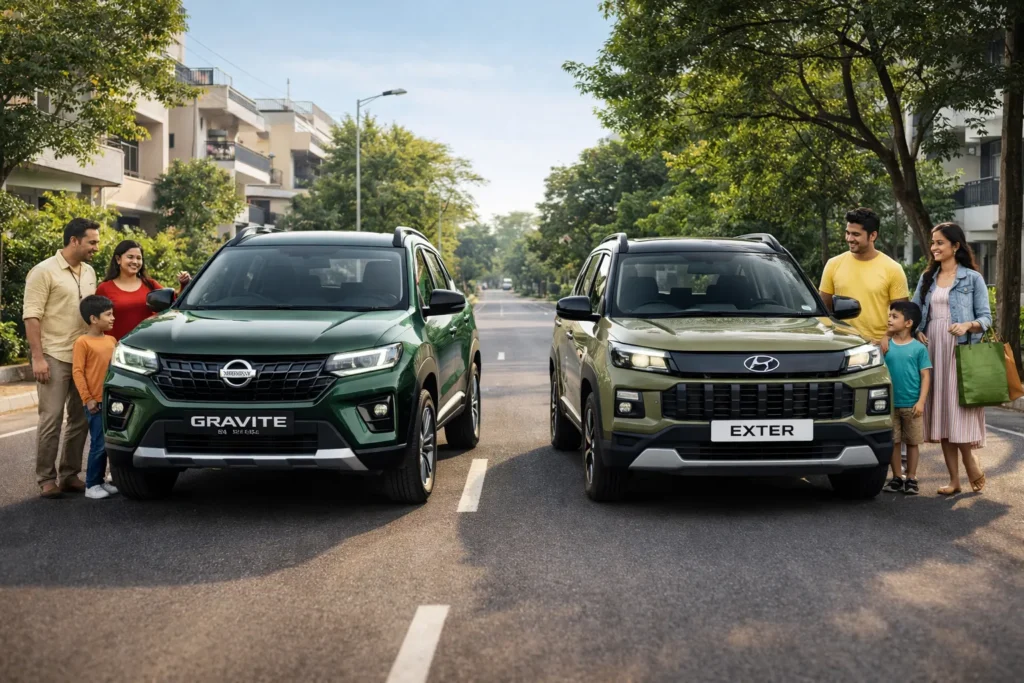
At first glance, the Nissan Gravite vs Hyundai Exter comparison seems unusual. One’s a 7-seater MPV built for big Indian families; the other’s a feature-loaded micro SUV designed for urban couples and young professionals. They’re technically in different segments. But here’s why this comparison makes perfect sense in India: both cars sit in the ₹5.65–9.50 lakh price bracket, both target first-time car buyers and families upgrading from two-wheelers, and both are fighting for the same share of your wallet.
The Nissan Gravite, launched in February 2026, brings a 5+2 seating layout, removable third row, and 625 litres of boot space (in 5-seat mode) at a jaw-dropping starting price of ₹5.65 lakh. The Hyundai Exter counters with a premium cabin, sunroof, dashcam, 6 airbags, and the refinement of Hyundai’s proven 1.2-litre engine — all wrapped in a stylish SUV body that’s crossed 2 lakh sales in India. So when a young family in Lucknow, Indore, or Nashik walks into a showroom with ₹8 lakh to spend, the Nissan Gravite vs Hyundai Exter dilemma is very real.
In this detailed comparison, we’re analysing the Nissan Gravite vs Hyundai Exter across every parameter that matters — price, seating, space, engine, mileage, features, safety, service network, and ownership costs. By the end, you’ll know exactly which car fits your life better — the one with extra seats or the one with extra style.
7 Seats vs 5 SeatsThe fundamental difference — Gravite offers 5+2 seating with removable third row; Exter is a strictly 5-seater micro SUV
Nissan Gravite vs Hyundai Exter: Complete Specs Comparison
Here’s the full Nissan Gravite vs Hyundai Exter spec sheet. Despite being from different segments, the price overlap makes this comparison essential for budget-conscious Indian buyers.
| Specification | Nissan Gravite | Hyundai Exter |
|---|---|---|
| Price Range | ₹5.65 – 8.94 Lakh ✓ | ₹5.64 – 9.38 Lakh |
| Body Type | Sub-4m MPV (5+2 seater) | Micro SUV (5 seater) |
| Seating Capacity | 7 (5+2 removable) ✓ | 5 |
| Engine | 1.0L NA Petrol (71 hp, 96 Nm) | 1.2L NA Petrol (82 hp, 114 Nm) ✓ |
| Transmission | 5MT / 5AMT | 5MT / 5AMT |
| CNG Option | Coming soon | Yes — 27.1 km/kg ✓ |
| Mileage (Petrol ARAI) | 19.3 – 19.6 kmpl | 19.2 – 19.4 kmpl |
| Length | 3,995 mm ✓ | 3,815 mm |
| Width | 1,739 mm ✓ | 1,710 mm |
| Height | 1,643 mm ✓ | 1,631 mm |
| Wheelbase | 2,636 mm ✓ | 2,450 mm |
| Ground Clearance | ~185 mm | 185 mm |
| Boot Space | 625L (5-seat) / 84L (7-seat) ✓ | 391 litres |
| Kerb Weight | ~947 kg | ~890 kg |
| Infotainment | 8″ Touchscreen | 8″ Touchscreen ✓ |
| Wireless CarPlay/Auto | Yes | Yes |
| Sunroof | No ✗ | Yes (Electric) ✓ |
| Dashcam | No ✗ | Yes (Dual camera, factory) ✓ |
| Wireless Charger | Yes | Yes |
| Auto Climate Control | Yes | Yes |
| Rear AC Vents | Yes (2nd + 3rd row) ✓ | Yes (2nd row only) |
| Airbags | 6 (Standard) | 6 (Standard) |
| ESC + Hill Assist | Yes | Yes |
| TPMS | Yes | Yes |
| Safety Rating | Not yet tested | Not yet tested |
| Warranty | 5 Years free service (first 5000 bookings) ✓ | 3 Years / Unlimited km |
| Service Network | ~350 Nissan touchpoints | 1,500+ Hyundai centres ✓ |
Key Takeaway: The Gravite wins on space, seating, and value. The Exter wins on engine refinement, features (sunroof, dashcam), and Hyundai’s massive service network. This Nissan Gravite vs Hyundai Exter comparison is a classic “space vs features” battle.
Price Comparison: Both Start Under ₹6 Lakh — But Value Differs
Base Variant Analysis
The Nissan Gravite vs Hyundai Exter price battle starts neck-and-neck. The Gravite Visia MT begins at ₹5.65 lakh while the Exter EX MT starts at ₹5.64 lakh — just ₹1,000 difference. But the Gravite base gives you a 7-seater body with LED lighting and 30+ safety features, while the Exter base is stripped down with minimal features. At the entry level, the Gravite offers dramatically more car for nearly the same money.
Sweet Spot ₹7–8 Lakh Range
This is where most buyers will shop in the Nissan Gravite vs Hyundai Exter comparison. The Gravite N-Connecta (~₹7.5L) gets you an 8-inch touchscreen, wireless CarPlay, wireless charger, cruise control, and auto LED headlamps — plus 7 seats. The Exter S (~₹7.6L) gets you similar infotainment features PLUS a sunroof — but only 5 seats. The question is brutally simple: do you need extra seats or a sunroof?
Top-Variant Comparison
The Gravite Tekna Launch Edition tops out at ₹8.94 lakh. The Exter SX(O) Connect Knight AMT hits ₹9.38 lakh. The Exter top-end adds paddle shifters, dual dashcam, connected car tech, and Knight Edition styling. The Gravite top-end adds premium suede-leatherette seats and an air purifier. For feature-seekers, the Exter justifies its premium. For space-seekers, the Gravite offers an unmatched 7-seat package under ₹9 lakh.
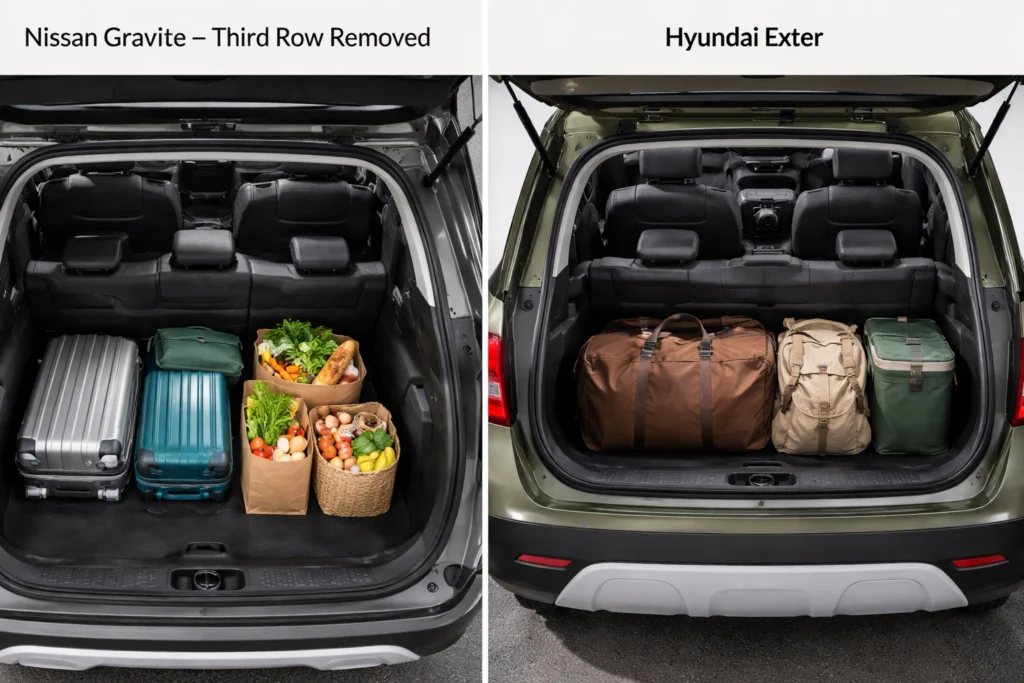
625L vs 391LBoot space in 5-seat mode — the Gravite carries 60% more luggage than the Exter. Game-changing for family road trips.
Space & Seating: The Gravite’s Biggest Advantage
7 Seats for Under ₹6 Lakh — Only the Gravite Does This
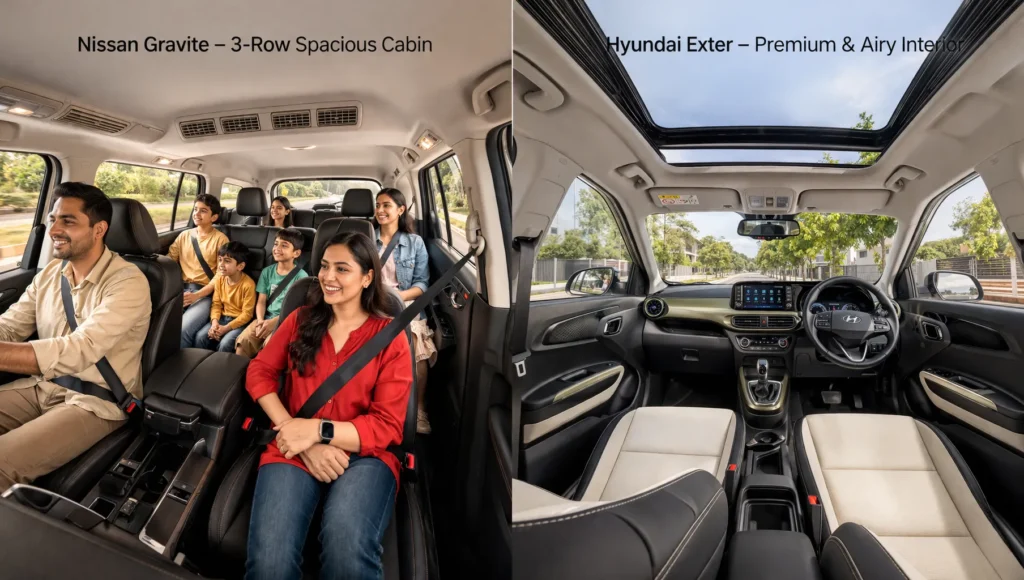
The single biggest USP of the Nissan Gravite in the Nissan Gravite vs Hyundai Exter comparison is its 5+2 seating layout. The second row slides, reclines, folds, and tumbles — giving you incredible flexibility. The third row is fully removable, so when you don’t need 7 seats, you get a massive 625-litre boot. For a joint Indian family where you occasionally carry parents, in-laws, or extra kids, this versatility is priceless. No micro SUV at any price can match this.
But the Exter’s 5-Seat Cabin Is More Comfortable
The Hyundai Exter, being a dedicated 5-seater, offers more comfort per passenger. The seats are better cushioned, the rear legroom is more generous per-passenger, and the overall ride quality is less compromised because there’s no third-row engineering to worry about. The Exter’s 1.2-litre 4-cylinder engine is smoother and more refined than the Gravite’s 1.0-litre 3-cylinder unit, which makes highway cruising noticeably more pleasant. If your typical car usage is 4-5 people and you rarely need extra seats, the Exter delivers a more premium daily experience.
Boot Space Comparison
With all 7 seats up, the Gravite’s boot shrinks to just 84 litres — barely enough for a backpack. With the third row removed (5-seat mode), it expands to 625 litres — enormous for this price range. The Exter offers a fixed 391-litre boot. For the Nissan Gravite vs Hyundai Exter buyer who does weekly Big Bazaar runs or carries sports equipment, the Gravite in 5-seat mode is the clear winner. But if you always use 7 seats AND need boot space simultaneously, neither car is ideal.
Engine & Mileage: Exter’s Refinement vs Gravite’s Adequacy
Power and Performance
The Hyundai Exter’s 1.2-litre 4-cylinder engine (82 hp, 114 Nm) is noticeably smoother and more powerful than the Gravite’s 1.0-litre 3-cylinder (71 hp, 96 Nm). The Exter has 15% more power and 19% more torque — and you feel this difference during highway overtakes, uphill climbs, and when the car is fully loaded with 5 passengers. The Gravite feels adequate for city commuting but genuinely struggles when fully loaded with 7 passengers on highway inclines. Multiple reviewers have noted that the Gravite’s 1.0-litre engine feels strained with a full load.
Mileage Comparison
ARAI mileage is nearly identical: Gravite claims 19.3–19.6 kmpl, Exter claims 19.2–19.4 kmpl. Real-world city mileage for both sits around 14-16 km/l with AC. The Exter’s CNG option (27.1 km/kg) gives it a massive running cost advantage for high-mileage city commuters. The Gravite’s CNG variant is coming soon but isn’t available at launch. In the Nissan Gravite vs Hyundai Exter fuel economy comparison, the Exter’s CNG availability gives it the edge today.
Transmission: Both Get AMT — Neither Gets CVT or DCT
Both cars offer 5-speed manual and 5-speed AMT gearbox options. Neither gets a CVT or torque converter automatic, which means you’ll experience the typical AMT “head nod” during gearshifts in both cars. The Exter’s AMT is slightly better calibrated and even gets paddle shifters on the top variant — a fun touch for city driving. The Gravite’s AMT (called EZ-Shift by Nissan) is functional but unremarkable.
Features & Technology: Exter’s Premium Touches Win
Exter’s Feature Advantage
The Hyundai Exter packs segment-first features that the Gravite simply doesn’t match: an electric sunroof (from S variant onwards), factory-fitted dual dashcam (front + rear), paddle shifters on AMT, connected car technology with Hyundai BlueLink, and a more refined 8-inch infotainment system. These aren’t just spec-sheet items — they genuinely improve daily ownership experience. The sunroof alone is a major emotional draw for first-time car buyers in India. In the Nissan Gravite vs Hyundai Exter features battle, the Exter feels like a ₹10 lakh car priced at ₹8 lakh.
Gravite’s Practical Features
The Gravite counters with practical, family-oriented features: 8 AC vents (four up front, one on each B-pillar, two on the roof), a cooled lower glove box, independent rear AC control, wireless charging, and cruise control. The cabin has more storage spaces designed for Indian family use — bottle holders, tray tables, and cubby holes are generously distributed. For a family of 6-7, these practical touches matter more than a sunroof. The Gravite also offers premium suede-leatherette quilted seats on the top variant, which look and feel surprisingly upmarket for this price.
Know More About: Renault Duster vs Hyundai Creta 2026: Can the Returning Legend Dethrone India’s #1 SUV?
Infotainment: Similar but Different
Both get 8-inch touchscreens with wireless Android Auto and Apple CarPlay. The Exter’s system feels marginally snappier and the interface is more polished. The Gravite’s system is the same Renault-derived unit from the Triber — functional but not as premium-feeling. Both get digital instrument clusters, though the Exter’s 4.2-inch MID feels more informative. In the Nissan Gravite vs Hyundai Exter tech comparison, the Exter’s infotainment edge is noticeable but not dramatic.
Safety: Both Well-Equipped — But Neither Crash-Tested
Both the Gravite and Exter come with 6 airbags standard, ESC, ABS with EBD, TPMS, ISOFIX, hill-start assist, and reverse parking sensors. The Gravite adds traction control and brake assist as standard. The Exter adds a dual dashcam and SOS call feature. Neither car has been crash-tested by Global NCAP or Bharat NCAP as of March 2026, so we can’t definitively say which is structurally safer. The Nissan Gravite vs Hyundai Exter safety comparison is essentially a draw on paper, with both offering robust equipment for this price segment.
After-Sales & Ownership: Hyundai’s Massive Advantage
Service Network Reality
This is where the Nissan Gravite vs Hyundai Exter comparison tilts heavily. Hyundai operates 1,500+ service centres across India — from metros to tier-3 towns. Nissan has approximately 350 touchpoints, which Nissan is actively expanding but remains significantly smaller. If you’re in a city like Ranchi, Bhopal, Dehradun, or Vijayawada, finding a Hyundai service centre is trivial; finding a Nissan one requires more effort.
Launch Offers and Warranty
Nissan is aggressively sweetening the deal for early Gravite buyers: the first 5,000 bookings get 5 years of complimentary service — a massive ownership cost advantage. Hyundai offers a standard 3-year/unlimited km warranty with optional extended warranty packages. For early adopters, the Gravite’s 5-year free service offer significantly reduces the after-sales concern.
Resale Value
Hyundai Exter holds better resale thanks to the brand’s strong reputation and 2 lakh+ units already on Indian roads. The Gravite is a brand-new nameplate (launched Feb 2026), so its resale trajectory is unproven. If resale matters to you, the Exter is the safer bet in the Nissan Gravite vs Hyundai Exter ownership comparison.
Who Should Buy Which? Our Final Verdict
The Nissan Gravite vs Hyundai Exter decision comes down to one fundamental question: what does your family need more — extra seats or extra features?
Buy Nissan Gravite If…
You have a joint family or 5+ regular passengers. Third row is needed even occasionally (parents, in-laws, kids’ friends). Boot space matters — 625L in 5-seat mode is unbeatable. Budget is under ₹7 lakh and you want maximum car for money. You can grab the 5-year free service offer (first 5000 bookings). Value and practicality over premium feel.
Buy Hyundai Exter If…
You’re a couple, nuclear family, or max 5 regular passengers. Sunroof, dashcam, and premium feel matter to you. You want the smoother, more powerful 1.2L engine. CNG option is important for low running costs. You value Hyundai’s 1,500+ service network. Resale value and brand trust are priorities. City driving with occasional highway trips.
Our Take: For most Indian nuclear families (4-5 people) who prioritise features, refinement, and ownership ease, the Hyundai Exter is the smarter choice. For larger families or anyone who regularly carries 6-7 people on a budget under ₹9 lakh, the Nissan Gravite is genuinely the only game in town — no other 7-seater comes close to this price. The Nissan Gravite vs Hyundai Exter comparison doesn’t have a universal winner — it has two cars that solve completely different problems at the same price.
Test Drive Both Before You Decide!
Visit your nearest Nissan or Hyundai showroom for a back-to-back test drive. Load the Gravite with 7 people and see if the third row works for your family. Experience the Exter’s sunroof and engine refinement. The right car is the one that fits YOUR life, not the spec sheet.
Nissan Gravite — Strengths & Weaknesses
✓ Strengths
✓ Only 7-seater under ₹6 lakh in India
✓ 625L boot space (5-seat mode) — class-leading
✓ Removable third row — brilliant flexibility
✓ 8 AC vents — comfort for all 3 rows
✓ 30+ standard safety features, 6 airbags
✓ 5 years free service (first 5000 bookings)
✓ Proven Triber platform — reliable mechanicals
✗ Weaknesses
✗ 1.0L engine (71 hp) — underpowered with full load
✗ No sunroof — dealbreaker for some buyers
✗ No dashcam, no connected car tech
✗ ~350 Nissan service centres — limited reach
✗ Third row is tight for adults
✗ Unproven resale value (new nameplate)
✗ CNG not available at launch
Hyundai Exter — Strengths & Weaknesses
✓ Strengths
✓ 1.2L engine — smoother, more powerful (82 hp)
✓ Electric sunroof — segment highlight
✓ Dual dashcam (factory fitted) — segment first
✓ CNG option — 27.1 km/kg for low running costs
✓ 1,500+ Hyundai service centres — best reach
✓ 2 lakh+ units sold — proven reliability
✓ Premium styling, Knight Edition available
✗ Weaknesses
✗ Only 5 seats — no third row option
✗ 391L boot — significantly less than Gravite
✗ Rear seat under-thigh support is weak
✗ City mileage drops to 8-10 kmpl with AC (user reports)
✗ No rear disc brakes on any variant
✗ Base variant is under-equipped
✗ Feels like a tall hatchback, not a true SUV
Must read: Best Petrol Car for Daily Commute in Delhi NCR: Complete Buyer’s Guide 2026
Frequently Asked Questions
Q1. Nissan Gravite vs Hyundai Exter — which is cheaper?
Both start at nearly the same price: Gravite at ₹5.65 lakh, Exter at ₹5.64 lakh (ex-showroom). The Gravite top variant (₹8.94L) is cheaper than the Exter top variant (₹9.38L). At every price point in the Nissan Gravite vs Hyundai Exter comparison, you get more space with the Gravite and more features with the Exter.
Q2. Nissan Gravite vs Hyundai Exter — which has more space?
The Nissan Gravite is significantly more spacious. It’s longer (3,995mm vs 3,815mm), wider (1,739mm vs 1,710mm), has a longer wheelbase (2,636mm vs 2,450mm), offers 7 seats vs 5, and has 625L boot space in 5-seat mode vs the Exter’s 391L. For families needing space and flexibility, the Gravite wins decisively.
Q3. Which has better mileage — Gravite or Exter?
ARAI mileage is nearly identical: Gravite at 19.3-19.6 kmpl, Exter at 19.2-19.4 kmpl. Real-world city mileage for both is 14-16 km/l. However, the Exter’s CNG option delivers 27.1 km/kg — far more economical for high-mileage users. The Gravite CNG is coming soon but isn’t available at launch. For running cost efficiency, the Exter CNG wins in the Nissan Gravite vs Hyundai Exter mileage comparison.
Q4. Is the Nissan Gravite’s third row usable for adults?
The third row is best suited for children and short trips for adults. Knee room and under-thigh support are limited, as expected in a sub-4-metre MPV. However, the second row slides forward to create more legroom for third-row passengers. For occasional use (picking up in-laws, school runs, short family trips), it’s perfectly adequate. For daily long-distance use by adults, it’s too cramped.
Q5. Nissan Gravite vs Hyundai Exter — which engine is better?
The Hyundai Exter’s 1.2L 4-cylinder (82 hp, 114 Nm) is smoother, more refined, and more powerful than the Gravite’s 1.0L 3-cylinder (71 hp, 96 Nm). The Exter handles highway speeds and full-load conditions noticeably better. The Gravite’s engine is adequate for city commuting but struggles when carrying 7 passengers uphill or at highway speeds. For performance, the Exter wins clearly.
Q6. Does the Nissan Gravite have a sunroof?
No, the Nissan Gravite does not offer a sunroof on any variant. If a sunroof is important to you, the Hyundai Exter offers an electric sunroof from the S variant onwards (around ₹7.03 lakh). This is one of the Exter’s biggest emotional advantages in the Nissan Gravite vs Hyundai Exter comparison.
Q7. Nissan Gravite vs Hyundai Exter — which has better after-sales service?
Hyundai wins with 1,500+ service centres across India versus Nissan’s approximately 350 touchpoints. Hyundai’s reach in tier-2 and tier-3 cities is significantly better. However, Nissan is offering 5 years free service for the first 5,000 Gravite bookings — which substantially reduces the service network concern for early buyers.
Q8. Can the Nissan Gravite replace an Ertiga or Bolero for a large family?
For city commuting and short trips, yes. The Gravite’s 5+2 layout handles 7 passengers adequately for daily school/office runs and weekend outings. However, it cannot replace an Ertiga for long highway trips with 7 adults — the 1.0L engine is too weak and the third row too cramped for extended highway use. Think of the Gravite as a city-focused 7-seater, not a highway-oriented MPV.
Q9. Which is better for a first-time car buyer — Gravite or Exter?
For a first-time buyer who’s a young couple or small family (3-4 people), the Hyundai Exter offers better refinement, features, brand trust, and driving experience. For a first-time buyer who’s upgrading from a two-wheeler for a larger family (5-6 people), the Nissan Gravite’s 7-seat versatility at under ₹6 lakh is impossible to beat. The Nissan Gravite vs Hyundai Exter choice for first-time buyers depends entirely on family size.
Q10. Nissan Gravite vs Hyundai Exter — final verdict?
Buy the Gravite if you need 7 seats on a budget — it’s the only car in India offering this at under ₹6 lakh. Buy the Exter if you want a premium, feature-rich micro SUV with a refined engine and Hyundai’s unmatched service network. Both are excellent value for money — the right choice depends on whether you need extra seats (Gravite) or extra features (Exter).
Know More: Royal Enfield Classic 350 vs Bullet 350: The Real Difference Every Buyer Must Know in 2026