If you’ve been searching for “Hyundai HE1i electric SUV” details, you’ve landed in the right place. Hyundai’s most ambitious made-in-India electric vehicle is now deep into road testing — and the details that have emerged are genuinely exciting for Indian EV buyers.
Following the Creta Electric’s launch in early 2025, Hyundai is now aggressively developing a second India-focused EV — the Hyundai HE1i electric SUV. This isn’t a carryover global model with minor tweaks; it’s being engineered ground-up for Indian roads, Indian price sensitivity, and Indian buyer expectations. Testing has extended from South Korea to Mumbai’s chaotic city streets, and fresh spy shots confirm the design and features are now largely locked in.
With less than a year to launch (estimated late 2026 to early 2027), here’s a comprehensive breakdown of everything officially known, credibly rumoured, and strategically inferred about the Hyundai HE1i electric SUV.
₹10 Lakh (Est. Starting Price)
The Hyundai HE1i is expected to enter the segment at an aggressive ₹10–15 lakh bracket, directly targeting the Tata Punch EV. (Source: Autocar India)
Hyundai HE1i Design: What Do the Spy Shots Reveal?
The Hyundai HE1i electric SUV is making a bold design statement — and it’s one that’s clearly aimed at the heart of the Indian SUV buyer psyche. Forget the softened curves of its Korean siblings. This one is built boxy, upright, and unapologetically rugged.
Exterior: Boxy and Built for India
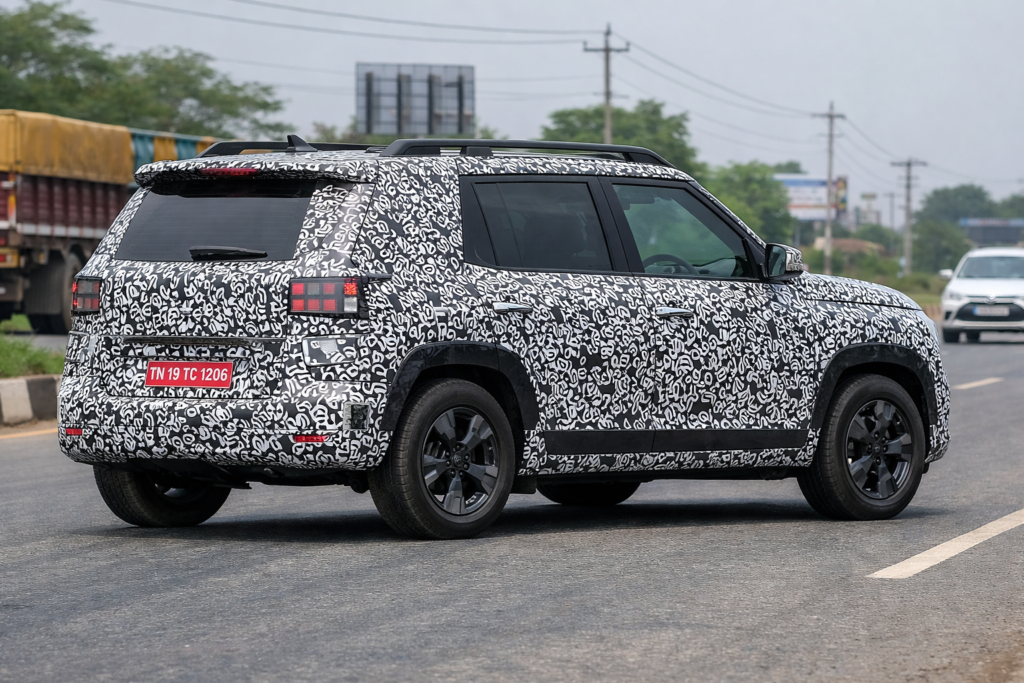
The spy shots, first captured in Mumbai and later in multiple Indian cities, show a sub-4 metre electric SUV with an upright A-pillar, squared-off windows, an almost flat roofline, raised roof rails, and extremely short front and rear overhangs. These attributes aren’t accidental — Hyundai has clearly studied what makes the Tata Punch so appealing to Indian buyers: maximum perceived road presence in a compact footprint.
The charging port sits behind the left-side front quarter panel — a clean, purposeful placement that confirms this is a dedicated EV platform (not an ICE conversion). Flared wheel arches wrapped with rugged plastic body cladding further add to the off-road-ready aesthetic, even though this will be a front-wheel-drive urban electric SUV.
Lighting: Ioniq DNA on a Budget
This is where the Hyundai HE1i electric SUV gets genuinely interesting. The front features a split headlamp setup with Pixel-inspired LED DRLs — a design language lifted directly from the Ioniq 5 and Inster EV. The four-dot front fascia even incorporates Morse code for the letter ‘H’, a signature element across Hyundai’s next-generation EV lineup. At the rear, pixelated LED tail lights are visible through the camouflage, giving the car a distinctly premium visual identity that punches well above its expected price point.
Additional premium touches include flush-fitting door handles, 16-inch dual-tone diamond-cut alloy wheels in an aerodynamic design, large ORVMs with camera modules (likely for the 360-degree surround system), and a shark-fin antenna.
Hyundai HE1i Interior: Premium Features at a Mass-Market Price?
Based on spy shot glimpses and Hyundai’s declared specs for the platform, the Hyundai HE1i electric SUV’s interior is expected to be the most surprising part of the package — genuinely premium by segment standards.
Screens, Tech, and Connectivity
Expect a 12.9-inch touchscreen infotainment system with Google Built-in integration (similar to the new Venue and Creta), paired with a 9.9-inch slim digital instrument cluster. This dual-screen setup mirrors the Ioniq-family’s cockpit approach and is a significant step above anything the Tata Punch EV currently offers. Wireless Android Auto and Apple CarPlay are expected as standard on higher trims.
Connected car tech will be a strong selling point. Hyundai’s BlueLink-style connected suite, with over-the-air updates, remote vehicle control via smartphone, and smartwatch connectivity, is expected to be baked in across variants.
Comfort and Safety Features
The expected feature list of the Hyundai HE1i electric SUV includes:
- Single-pane electric sunroof
- Ventilated front seats
- Wireless smartphone charger
- 360-degree camera system
- Ambient lighting
- Six airbags (likely standard across all variants)
- Level 2 ADAS suite (on top trims)
- Auto climate control
The six-airbag setup would make the Hyundai HE1i electric SUV one of the safest offerings in the micro-SUV segment — particularly significant as Bharat NCAP crash test norms tighten through 2026–27.
The Hyundai HE1i is expected to offer six airbags as standard — a segment-first claim at this price point. Hyundai and Kia both recently scored 5-star Bharat NCAP ratings for their 2026 models. (Source: Smartprix / Bharat NCAP)
Hyundai HE1i Battery, Range & Charging: What You Need to Know
The powertrain story of the Hyundai HE1i electric SUV is where Hyundai has made some very deliberate — and commendable — localisation decisions.
LFP Cells from Exide Energy: The Localisation Advantage
Hyundai will source LFP (Lithium Iron Phosphate) prismatic cells from Exide Energy Solutions Limited (EESL) — a wholly owned subsidiary of Exide Industries. EESL is building India’s first gigafactory in Bengaluru with a targeted annual capacity of 12 GWh. This local sourcing strategy is critical: it allows Hyundai to keep costs low enough to hit the sub-₹10 lakh starting price target while also qualifying for government EV incentives under FAME and PLI schemes.
LFP chemistry also means the Hyundai HE1i electric SUV will have significantly better thermal stability in Indian summer conditions (where temperatures regularly cross 45°C in cities like Nagpur and Jaipur), longer cycle life, and no degradation anxiety — a key concern for Indian EV buyers.
Battery Pack Options and Range
Two battery pack options are expected, mirroring the global Hyundai Inster EV (which is available in 42 kWh and 49 kWh variants internationally). The India-spec versions may be slightly recalibrated for local conditions and pricing. The extended-range variant is expected to deliver 475–500 km on a single ARAI charge, which — if confirmed — would be among the highest range figures in the segment. The standard variant will likely offer 300–350 km.
Both variants are expected to use front-axle-mounted electric motors, with locally sourced motors also on the table. DC fast charging support (up to 65 kW) is expected, allowing a 20–80% charge in approximately 30 minutes.
Hyundai HE1i Price in India: How Much Will It Cost?
Price is everything in this segment, and Hyundai knows it. The Hyundai HE1i electric SUV price in India is expected to start at approximately ₹10 lakh (ex-showroom), with the range topping out around ₹15 lakh for the fully loaded extended-range variant.
This positions the Hyundai HE1i directly against the 2026 Tata Punch EV facelift, which currently starts at ₹9.69 lakh (without BaaS) and goes up to ₹12.59 lakh. Hyundai’s strong brand equity, larger feature count, and longer claimed range could justify a slight premium over the Punch EV — but staying within that ₹10–13 lakh sweet spot will be critical for high-volume sales.
The Hyundai HE1i electric SUV will be manufactured at Hyundai’s Sriperumbudur plant in Tamil Nadu, with a target of 65,000 units annually. This high-volume, highly localised production plan is specifically designed to keep prices competitive and qualify for production-linked incentives. A portion of HE1i production will also be exported — particularly to the EU under the new India-EU Free Trade Agreement.
Hyundai’s Sriperumbudur plant will target 65,000 annual units of the HE1i, making it a key volume driver in Hyundai’s India EV strategy. (Source: Electrive.com)
Hyundai HE1i vs Tata Punch EV: Full Comparison (2026)
This is the battle every Indian EV buyer wants answered. Here’s how the Hyundai HE1i electric SUV stacks up against its primary competitor based on current available information:
| Specification | Hyundai HE1i (Expected) | Tata Punch EV 2026 Facelift |
|---|---|---|
| Expected Price | ₹10–15 lakh (est.) | ₹9.69–12.59 lakh |
| Body Style | Boxy Compact Electric SUV | Micro Electric SUV |
| Battery Options | ~42 kWh & ~49 kWh (est.) | 30 kWh & 40 kWh |
| Battery Chemistry | LFP (Exide Energy, India) | LFP (NMC for upper variant) |
| Max ARAI Range | 475–500 km (est.) | 468 km (40 kWh, ARAI) |
| Motor Drive | Front-Wheel Drive | Front-Wheel Drive |
| Infotainment | 12.9-inch touchscreen | 10.25-inch touchscreen |
| Instrument Cluster | 9.9-inch digital | 10.25-inch digital |
| Sunroof | Electric Single-Pane (exp.) | Single-Pane (select variants) |
| 360° Camera | Yes (expected) | Yes (top variants) |
| Ventilated Seats | Yes (expected) | Yes (top variants) |
| Airbags | 6 (expected) | 6 (select variants) |
| Fast Charging | Yes, ~65 kW DC (est.) | Yes, 65 kW DC |
| Manufacturing | Sriperumbudur, India | Pune, India |
| Launch | Late 2026 / Early 2027 | Already launched (Feb 2026) |
| BaaS Option | TBA | Yes (from ₹6.49 lakh) |
Hyundai HE1i: Pros & Cons
Expected Strengths
- Longer range (475–500 km est.)
- Larger infotainment (12.9-inch)
- Ioniq-family pixel LED design
- Premium interior with ambient lighting
- Highly localised — LFP cells from India
- Strong Hyundai service network (1,500+ centres)
- Potential export to EU under FTA
Potential Weaknesses
- Not launched yet — specs may change
- No BaaS option confirmed yet
- Slightly higher expected starting price
- Creta Electric underperformed (700 units/month)
- Charging infrastructure still thin in Tier-2 cities
When Will the Hyundai HE1i Launch in India?
Road testing of the Hyundai HE1i electric SUV has progressed from controlled South Korean tracks to full public road testing in Indian cities — a strong sign that the development phase is in its final stretch. As of April 2026, the expected launch window is late 2026 to early 2027.
Platform & Name: Could It Be the Ioniq 1?
The ‘E’ in the codename HE1i follows a clear pattern: Ioniq 5 was coded ‘NE’, Ioniq 6 was ‘CE’, and Ioniq 9 was ‘ME’. This strongly points toward the Hyundai HE1i electric SUV eventually being launched as the ‘Ioniq 1’ — the most affordable and accessible member of the Ioniq family. It would be based on the E-GMP (K) platform — the same affordable skateboard architecture that underpins the global Hyundai Inster EV.
However, given this is a heavily India-localised product, Hyundai may opt for a standalone name that better communicates value and accessibility to Indian buyers who aren’t yet familiar with the Ioniq brand.
Competition Landscape
By the time the Hyundai HE1i electric SUV launches, it will face a sharper competitive landscape. The 2026 Tata Punch EV facelift has already landed (Feb 2026, priced ₹9.69–12.59 lakh with a 40 kWh battery and 468 km ARAI range). Maruti Suzuki’s entry-level EV is also on the horizon. Hyundai will need to deliver on range, features, and after-sales experience to convert buyers from the Punch EV stronghold.
Should You Wait for the Hyundai HE1i or Buy the Tata Punch EV Now?
This is the real-world question on the minds of anyone looking at affordable EVs today. Here’s an honest take:
Buy the Tata Punch EV now if: you need a vehicle within the next 6–12 months, value the existing BaaS option (from ₹6.49 lakh), or want a proven ownership experience with Tata’s growing EV service infrastructure.
Wait for the Hyundai HE1i electric SUV if: you’re not in a hurry, want a longer range (475–500 km est.), prefer Hyundai’s feature density and brand assurance, or are coming from a Hyundai ownership background and want seamless service continuity.
Read More: Lowest Maintenance Cars in India 2026: Annual Cost Breakdown
Our Verdict
Buy Tata Punch EV (2026) if: you want an EV today, a proven product, and the flexibility of BaaS pricing from ₹6.49 lakh. It’s ready, it’s good, and it’s available.
Wait for Hyundai HE1i if: range is your top priority, you drive 80+ km daily (Noida–Gurgaon commuters, Bangalore IT corridor users), and you can wait until Q1 2027 for a product that may offer the segment’s longest ARAI range.
Overall: The Hyundai HE1i electric SUV has the potential to be a genuine segment disruptor — but only if Hyundai holds firm on the ₹10 lakh starting price and delivers on its range promise.
Conclusion: The Hyundai HE1i Electric SUV Could Change the Game
The Hyundai HE1i electric SUV isn’t just another upcoming car — it represents Hyundai’s most serious attempt yet at cracking India’s mass-market EV code. With deep localisation (LFP cells from Exide, local motors, Sriperumbudur manufacturing), aggressive expected pricing (starting ~₹10 lakh), and a feature list that borrows generously from the Ioniq family’s DNA, the HE1i could be the EV that finally challenges Tata Motors’ iron grip on affordable electric mobility in India.
The boxy, rugged design is smart — it speaks directly to Indian buyers who want a proper SUV character, not a rebadged hatchback. The pixel LED lighting and premium interior features show that Hyundai refuses to compromise on brand perception even at this price point.
Most blogs are comparing this to the Punch EV on specs alone. But here’s the real differentiator: Hyundai’s 1,500+ service centres across India, combined with the brand’s reputation for reliability and resale value, could tip the purchase decision in its favour even if the pricing comes in slightly above the Punch EV.
If you’re planning to buy an affordable electric SUV in 2026–27, the Hyundai HE1i electric SUV deserves a serious spot on your shortlist. Keep this page bookmarked — we’ll update it the moment official specs and pricing drop.
Frequently Asked Questions: Hyundai HE1i Electric SUV
What is the Hyundai HE1i electric SUV?
The Hyundai HE1i electric SUV is an upcoming made-in-India compact electric micro-SUV developed specifically for the Indian market. Codenamed ‘HE1i’ (the ‘i’ denoting India-specific version), it features a boxy design with Ioniq-family pixel LED lighting, locally sourced LFP batteries from Exide Energy, and a comprehensive feature list targeting the ₹10–15 lakh bracket. It is positioned as Hyundai’s primary challenger to the dominant Tata Punch EV in India’s fastest-growing EV segment. Road testing is ongoing in India and South Korea as of April 2026.
What is the expected price of Hyundai HE1i electric SUV in India?
The Hyundai HE1i price in India is expected to start at approximately ₹10 lakh (ex-showroom) for the base standard-range variant. The fully loaded extended-range model could be priced up to ₹15 lakh. This price bracket directly targets the 2026 Tata Punch EV (₹9.69–12.59 lakh) and the Citroen eC3. The aggressive pricing is made possible by Hyundai’s deep localisation strategy — LFP cells sourced from Exide Energy’s Indian gigafactory and local motor production. (Source: Autocar India)
When will the Hyundai HE1i launch in India?
The Hyundai HE1i electric SUV launch date in India is expected to be in late 2026 or early 2027. Road testing in Indian conditions has been underway since early 2026, with multiple test mules spotted in Mumbai and other cities. Hyundai is in the final stages of validation testing. An official unveil could happen at a major auto event or Hyundai press conference before the end of 2026.
Will the Hyundai HE1i be called the Ioniq 1?
The Hyundai HE1i electric SUV could potentially be launched as the ‘Ioniq 1’ — a theory supported by Hyundai’s consistent EV naming convention (Ioniq 5 = NE, Ioniq 6 = CE, Ioniq 9 = ME). The ‘E’ in HE1i fits this pattern perfectly. Additionally, its dimensions and positioning as an entry-level electric SUV make ‘Ioniq 1’ a logical name. However, Hyundai has not officially confirmed the name, and given the India-specific nature of this vehicle, a standalone non-Ioniq name remains possible.
What is the expected range of the Hyundai HE1i electric SUV?
The Hyundai HE1i range is expected to be 475–500 km (ARAI) for the extended-range variant, which would make it one of the longest-range electric micro-SUVs in India. The standard variant is likely to offer 300–350 km. Both figures are based on the global Hyundai Inster EV’s battery pack architecture (42 kWh and 49 kWh), recalibrated for Indian conditions with locally sourced LFP cells from Exide Energy.
How does the Hyundai HE1i compare to the Tata Punch EV?
The Hyundai HE1i vs Tata Punch EV comparison shapes up as a closely fought contest. The HE1i is expected to offer a larger 12.9-inch infotainment screen (vs Punch EV’s 10.25-inch), potentially longer range (475–500 km vs 468 km), and a more premium Ioniq-inspired design. The Tata Punch EV has the significant advantage of already being available, with a BaaS option starting as low as ₹6.49 lakh and Tata’s rapidly expanding EV-specific service infrastructure. If you need an EV now, the Punch EV is the clear choice; if you can wait 6–12 months, the HE1i may offer more value.
Where will the Hyundai HE1i be made?
The Hyundai HE1i electric SUV will be manufactured at Hyundai’s Sriperumbudur plant in Tamil Nadu — the same facility that produces the Creta, Verna, and Venue for India. Hyundai is targeting an annual production capacity of 65,000 units for the HE1i, with a significant portion planned for export. The India-EU Free Trade Agreement signed in early 2026 creates a clear export pathway for HE1i units to Europe, where it could compete with budget EVs like the Dacia Spring.
What battery does the Hyundai HE1i use?
The Hyundai HE1i battery will use LFP (Lithium Iron Phosphate) prismatic cells sourced locally from Exide Energy Solutions Limited (EESL). EESL’s new gigafactory in Bengaluru has a 12 GWh annual production capacity. LFP chemistry was chosen for its thermal stability in Indian heat conditions, longer battery lifespan, and lower cost versus NMC chemistry. This local sourcing also helps Hyundai qualify for FAME and PLI incentives, further supporting the sub-₹10 lakh base price target.
What features will the Hyundai HE1i have?
The Hyundai HE1i features are expected to include: a 12.9-inch touchscreen with Google Built-in, a 9.9-inch digital instrument cluster, pixel LED DRLs and tail lights, 16-inch dual-tone alloy wheels, electric sunroof, ventilated front seats, 360-degree camera, six airbags, ambient lighting, wireless smartphone charging, Level 2 ADAS (select variants), and connected car technology. This feature set significantly outclasses what’s available in the micro-SUV segment at this price point today.
Is the Hyundai HE1i electric SUV worth waiting for?
The Hyundai HE1i electric SUV is worth waiting for if: you want the longest range in the segment (475–500 km est.), prioritise a premium interior experience, value Hyundai’s 1,500+ service centre network, or are an existing Hyundai owner seeking to go electric. It’s not worth waiting for if you need a vehicle in the next 6 months, want the BaaS pricing model, or are on a tight budget below ₹10 lakh. Given the late 2026/early 2027 expected launch, buyers have time to test-drive the current competition before committing.